
Multi-nuclear transition metal catalysis
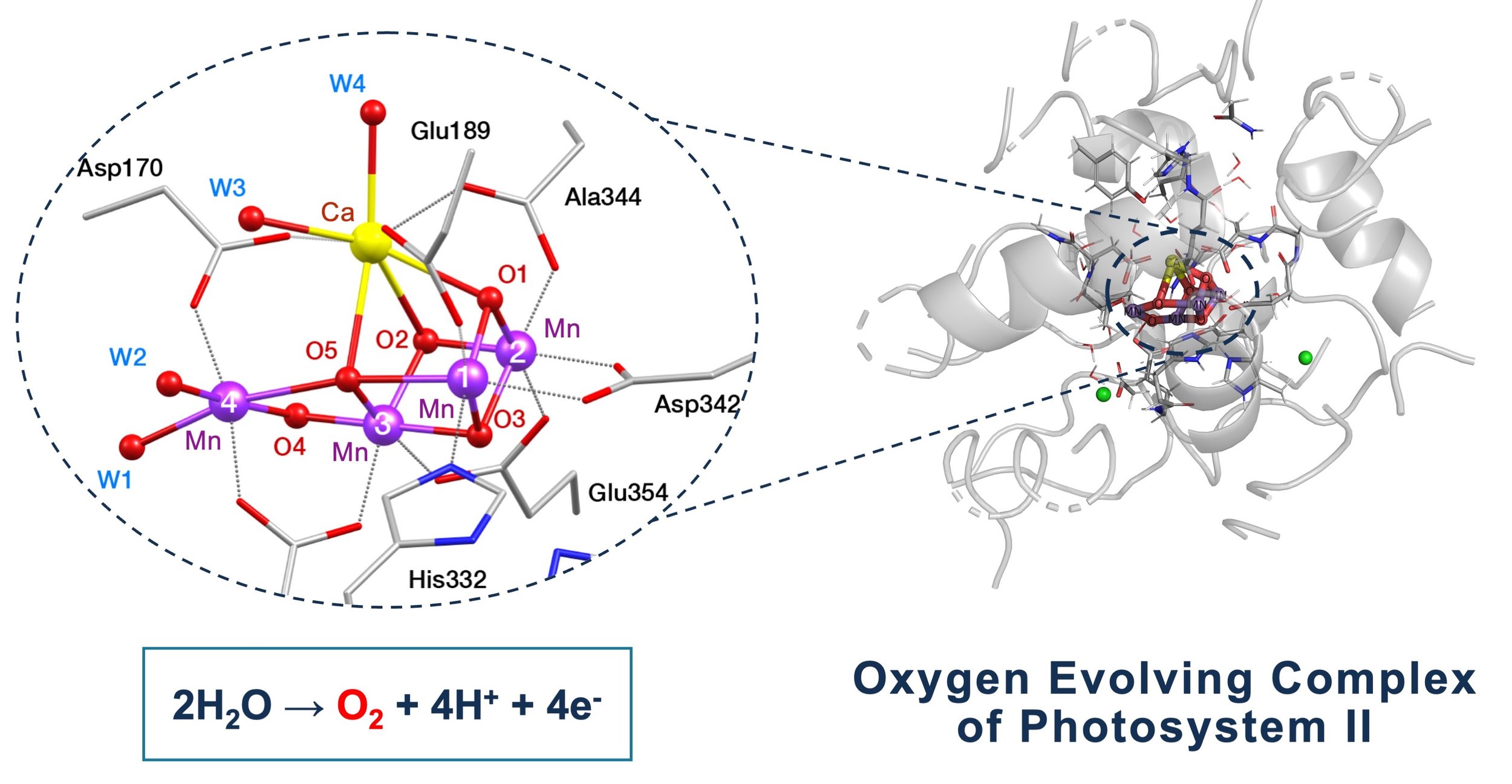
Nature created multi-nuclear metalloenzymes to catalyze some of the most demanding multi-electron transformations in biology, such as water oxidation and oxygen activation. In these systems, evolution arranged metal ions to operate in concert, enabling redox flexibility, access to different spin states, and structural polymorphism. We investigate the electronic structure and spectroscopy of bioinspired multi-nuclear catalysts to uncover the fundamental physical principles governing their activity.
Excited states of multichromophoric systems
In Photosynthesis, excitation energy is converted into electrochemical potential through charge separation in large pigment assemblies. We develop multi-scale models to understand energy transduction in multichromophoric supramolecular systems found in photosynthetic biomolecules and molecular materials. We are also interested in photo-generated multi-spin systems sensitive to external magnetic fields.

Computational spectroscopy of transition metal complexes
To correlate optical and magnetic spectroscopic parameters of complex systems, such as intermediates of transition metal catalysis, with their electronic and geometric structure, input from quantum chemical calculations is required. We develop new computational protocols to expand the limits of computational spectroscopy of large molecular open-shell systems, bridging experiment and theory.
